info@safarihq.com
+61 420 442 509 | +255 767 829 590
info@safarihq.com
+61 420 442 509 | +255 767 829 590
The 9-Day Northern Circuit Mount Kilimanjaro Trek is the ultimate adventure for trekkers looking to make the most of their Kilimanjaro experience! If you’re dreaming of an epic Kilimanjaro journey with jaw-dropping views, varied landscapes, and ample time to acclimatize, this route offers everything you need. Unlike shorter Kilimanjaro treks that rush you through, the 9-day Northern Circuit lets you enjoy a more relaxed pace, giving you time to absorb the breathtaking beauty of the mountain and its unique ecosystems.
One of the best things about the Northern Circuit is its scenic variety. From lush rainforests to vast alpine deserts and towering glaciers, you’ll feel like you’re trekking through several different worlds, all while circling the rugged northern slopes of Mount Kilimanjaro. As the least crowded route on the mountain, this trek gives you the opportunity to experience a quieter, more serene climb – ideal for those who want to enjoy Kilimanjaro's beauty without the crowds.
Additionally, if you’ve never climbed above 4,000 meters, the extra time on this route is a game-changer. The 9-day itinerary allows your body to acclimatize more gradually, significantly improving your chances of reaching Uhuru Peak without worrying about altitude sickness. The longer Kilimanjaro route provides a more comfortable ascent and gives your body the time it needs to adjust.
In short, if you’re looking to take your Kilimanjaro trek to the next level – stunning views, amazing landscapes, a peaceful atmosphere, and a better chance of summiting – the 9-Day Northern Circuit is the perfect choice! It’s not just about reaching the top, it’s about enjoying every moment of your Kilimanjaro adventure. Don’t just climb, experience the Roof of Africa like never before!
Day 1: Lemosho Trailhead to Lemosho Forest Camp
Elevation: 2,100 meters to 2,650 meters
Walking Time: 3–4 hours
Elevation Gain: 550 meters
Accommodation: Lemosho Forest Camp
Weather: Cool and pleasant, with some humidity due to the rainforest environment.
After a hearty breakfast at the hotel, you will embark on your first day of the trek, departing from Salinero Kilimanjaro Hotel to the Lemosho Trailhead. This drive takes approximately 2-3 hours and offers you an opportunity to admire the scenic beauty of the Tanzanian countryside as you head toward the western slopes of Mount Kilimanjaro.
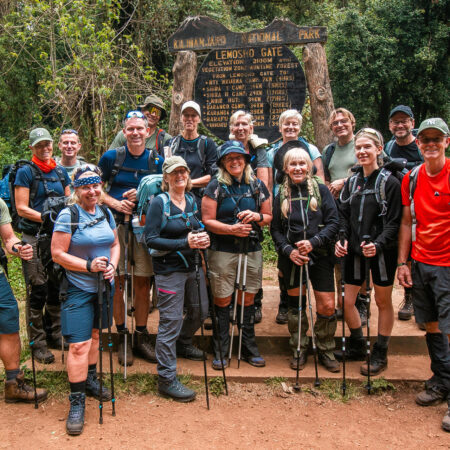
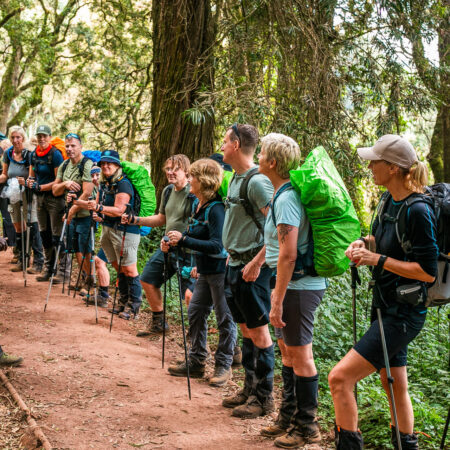
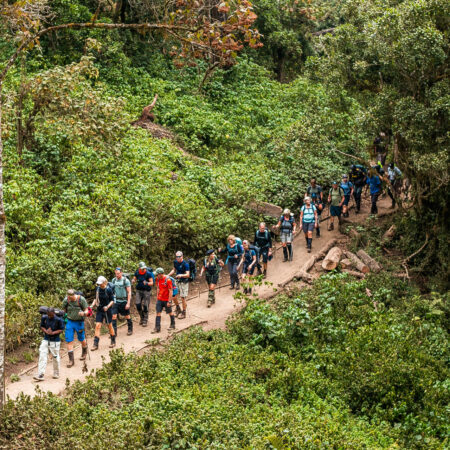
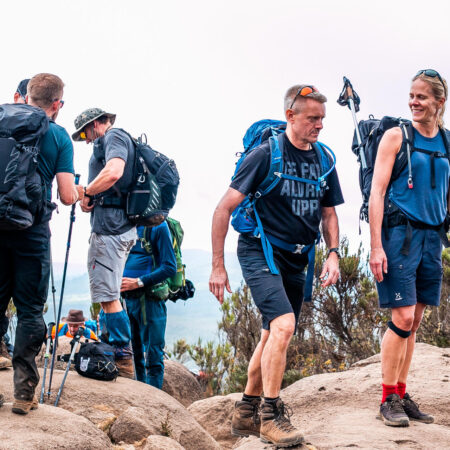
Once at the Lemosho Trailhead, the adventure truly begins. This is where you’ll meet your team of guides, porters, and chefs, who will ensure your safety and comfort throughout the trek. You’ll complete the necessary registration and start your hike into the lush Lemosho rainforest. The trail is relatively gentle as it winds through the vibrant forest, filled with the sounds of birds and monkeys.
The first day of trekking will take you through the dense forest, offering stunning views of the tropical flora and fauna. As you make your way to Lemosho Forest Camp, located at an elevation of 2,650 meters, you’ll notice the climate becoming cooler as you gain altitude. The trek today is moderate, with a total walking time of approximately 3-4 hours.
Upon reaching the camp, you can relax and enjoy a well-deserved meal, savoring the peacefulness of the forest surroundings. The night at Lemosho Forest Camp will be your first night on the mountain, where you’ll rest and acclimatize for the days ahead.
Highlights of the Day:
Scenic drive to the Lemosho Trailhead, with beautiful views of the Tanzanian countryside.
First day of trekking through the lush and vibrant rainforest.
Great introduction to the mountain, as you enjoy the peaceful atmosphere at Lemosho Forest Camp.
Opportunity to spot wildlife such as monkeys and various bird species.
Day 2: Lemosho Forest Camp to Shira 1 Camp
Elevation: 2,650 meters to 3,550 meters
Walking Time: 5–6 hours
Elevation Gain: 900 meters
Accommodation: Shira 1 Camp
Weather: Cooler temperatures as you ascend, with possible winds and clearer skies.
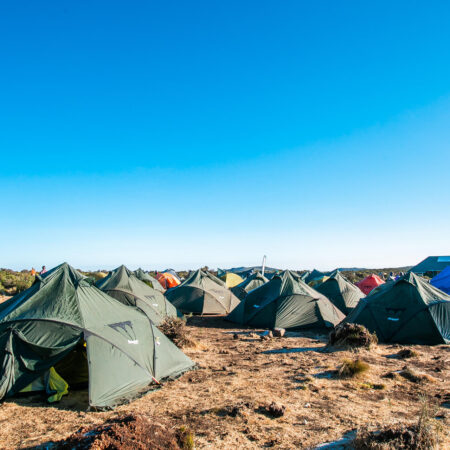
After a nutritious breakfast at Lemosho Forest Camp, you’ll continue your ascent toward Shira 1 Camp. The day’s hike takes you out of the rainforest and into the moorland zone, where the landscape becomes more open and dramatic. You’ll begin by trekking through a series of gentle ascents, leaving behind the dense forest and entering a world of alpine meadows and unique plant life.
The trail gradually climbs through this fascinating terrain, with opportunities to spot the iconic giant groundsels and other hardy species that thrive at these higher elevations. The journey is about 5-6 hours long, covering approximately 8 kilometers (5 miles). As you trek, you’ll be treated to panoramic views of Mount Kilimanjaro’s western slopes, with Kibo Peak looming in the distance, beckoning you onward.
While the day’s hike is relatively steady, the altitude gain to 3,550 meters means you’ll need to pace yourself. It’s important to remember the mantra “pole pole” (slowly, slowly) to allow your body to adjust to the increasing elevation. The air will become thinner, and the temperature will drop as you near Shira 1 Camp, so it’s advisable to wear layers and prepare for cooler conditions.
Upon arrival at Shira 1 Camp, you’ll have time to relax and enjoy the stunning views of the surrounding valleys and the plateau. The camp is located on the edge of the Shira Plateau, offering incredible vistas, making it a perfect spot to rest and acclimatize.
Highlights of the Day:
Trek through the beautiful moorland zone with breathtaking views of the mountain.
Spot unique plant species such as the giant groundsels, which are a hallmark of Kilimanjaro’s upper slopes.
Enjoy stunning panoramic views of the Kibo Peak and the expansive Shira Plateau.
A peaceful evening at Shira 1 Camp, where you can relax and acclimatize to the higher altitude.
Day 3: Shira 1 Camp (3,550 meters) to Shira 2 Camp (3,900 meters)
Elevation: 3,550 meters to 3,900 meters
Trekking Time: 4-5 hours
Habitat: Moorland
On Day 3 of your Mount Kilimanjaro trek, you’ll depart from Shira 1 Camp and head towards Shira 2 Camp, which is situated at 3,900 meters on the Shira Plateau. The day will be a relatively easy trek that will help your body adjust to the increasing altitude.
The distance covered is around 5–6 kilometers (3–4 miles), and you’ll gain approximately 350 meters in elevation. The path is a gradual climb, winding through the lush, rocky terrain of the moorland zone, with beautiful views of Mount Kilimanjaro’s western slopes. As you walk, you’ll pass unique, high-altitude plants like the famous giant groundsels and Dendrosenecio kilimanjari.
As you hike, it’s important to take it slow (“pole pole”) to allow your body to adjust to the thinning air. Though the hike is not too strenuous, the altitude can make it feel more challenging, so be sure to stay hydrated and take plenty of breaks.
Upon reaching Shira 2 Camp, you’ll be treated to panoramic views of the plateau and Kilimanjaro’s summit. The camp offers a peaceful resting place with plenty of opportunity for relaxation before continuing the journey.
Highlights of the Day:
Shira Plateau: Enjoy the stunning views as you trek across the expansive Shira Plateau, with expansive vistas of the surrounding valleys.
Giant Groundsels & Alpine Flora: See unique high-altitude plants, including the iconic giant groundsels.
Kibo Peak Views: The summit of Mount Kilimanjaro becomes increasingly visible as you ascend.
Shira 2 Camp: A peaceful camp with spectacular views of Kilimanjaro, perfect for acclimatization and rest.
Day 4: Shira 2 Camp (3,900 meters) to Lava Tower (4,630 meters) to Arrow Glacier (4,860 meters) to Moir Hut (4,200 meters)
Elevation: 3,900 meters to 4,200 meters
Trekking Time: 7-8 hours
Habitat: Alpine Desert
Elevation Gain: 800 meters to Lava Tower, followed by a descent of 430 meters to Moir Hut
Accommodation: Moir Hut
Day 4 is a challenging yet rewarding day on your Mount Kilimanjaro trek, taking you from Shira 2 Camp to Moir Hut. This day will involve a mix of climbing and descending, designed to help with acclimatization.
The trek begins with a steady ascent from Shira 2 Camp, heading towards the Lava Tower, one of the highest points on the route at 4,630 meters. The Lava Tower is a fascinating geological feature, a massive volcanic rock formation that provides a unique landscape and incredible views of the surrounding terrain. Along the way, you will experience the alpine desert zone, where the landscape is rugged and barren, with fewer plants and more volcanic rock. The air will begin to thin, making the trek feel more strenuous, so it’s important to continue at a slow, steady pace.
After reaching the Lava Tower, you will continue upwards to Arrow Glacier, which sits at 4,860 meters. Here, you will take a short acclimatization hike to help your body adjust to the altitude. After this, the trek will take a descent as you make your way to Moir Hut (4,200 meters) for the night. This descent will help your body acclimatize to the altitude and give your muscles a bit of relief before the more strenuous days ahead.
The Moir Hut offers incredible views of Mount Kilimanjaro’s peaks and surrounding areas, making it a perfect place to rest and relax after a challenging day.
Highlights of the Day:
Lava Tower: A stunning geological formation at 4,630 meters, providing panoramic views of the surrounding volcanic landscape.
Arrow Glacier Acclimatization: A short hike designed to help you adjust to the higher altitude and prepare for the summit attempt.
Descent to Moir Hut: After the climb, enjoy the beauty of Kilimanjaro’s alpine desert and rugged terrain as you descend to the lower altitude of Moir Hut for the night.
Moir Hut: A secluded, peaceful camp with magnificent views of the mountain, offering a good resting spot before continuing your journey.
Day 5: Moir Hut (4,200 meters) to Pofu Camp (4,000 meters)
Elevation: 4,200 meters to 4,000 meters
Trekking Time: 4-5 hours
Habitat: Alpine Desert
Elevation Loss: 200 meters
Accommodation: Pofu Camp
Day 5 on your Kilimanjaro adventure takes you from Moir Hut to Pofu Camp, offering a relatively short but vital trek that helps with acclimatization. Today’s route will provide spectacular views of the volcanic landscape and the towering peak of Mount Kilimanjaro.
After a hearty breakfast at Moir Hut, you’ll begin your trek with a steady descent from Moir Hut into the alpine desert. The trail is mostly gradual, making this day less strenuous compared to previous days. The terrain is rocky and sparse, and the vegetation becomes even more limited as you continue to gain altitude. However, the views of the surrounding valleys and the famous Kibo Peak grow even more magnificent as you get closer to Pofu Camp, which sits at 4,000 meters.
Although you are descending, you’ll still be at a high altitude, so it’s crucial to maintain your “pole pole” (slowly, slowly) pace to allow your body to continue adjusting to the thinner air. Along the way, you may see unique alpine desert plants and some wildlife, including birds and perhaps small mammals.
Pofu Camp is situated in a peaceful, isolated location with wide-open views of the mountain, offering a perfect spot to relax and acclimatize. It’s a smaller, quieter camp, which makes it an ideal environment to rest before you continue your ascent in the coming days.
Highlights of the Day:
Descent into the Alpine Desert: The route offers spectacular views of the volcanic landscape and Mount Kilimanjaro’s peak as you descend from Moir Hut.
Kibo Peak Views: As you approach Pofu Camp, the views of Kibo Peak become even more impressive.
Pofu Camp: Enjoy a peaceful, secluded camp with great opportunities for reflection and relaxation.
Day 6: Pofu Camp (4,000 meters) to Third Cave Camp (3,900 meters)
Elevation: 4,000 meters to 3,900 meters
Trekking Time: 4-5 hours
Habitat: Alpine Desert
On Day 6, you’ll leave Pofu Camp and begin your trek to Third Cave Camp, located at 3,900 meters. Today’s journey is a relatively short but important one, allowing your body to adjust to the altitude while taking in the rugged beauty of Mount Kilimanjaro’s alpine desert.
The trail starts with a steady climb through a barren, rocky landscape. As you trek higher, you’ll be surrounded by volcanic rock formations and other remnants of the mountain’s eruptive past. The vastness of the open terrain and the stunning views of Kibo Peak will be highlights of your day, with the mountain towering above you.
After a few hours of trekking, you will descend slightly to Third Cave Camp, which offers magnificent views of the surrounding valleys and the mountain’s glaciers. Third Cave is a quiet, secluded camp, giving you a peaceful spot to relax and enjoy your surroundings. Though the altitude is slightly lower than Pofu Camp, it’s still essential to take your time and continue trekking at a “pole pole” pace to help with acclimatization.
You’ll be able to enjoy the alpine desert’s serenity, spot some hardy plant life, and possibly catch sight of the incredible Dendrosenecio kilimanjari, the iconic plant species that thrives at these altitudes.
Highlights of the Day:
Alpine Desert Trekking: Trek through a rocky, volcanic landscape with stunning views of Kibo Peak.
Third Cave Camp: Spend the night at the peaceful Third Cave, offering fantastic views of the surrounding valleys and glaciers.
Dendrosenecio kilimanjari: Spot the iconic Kilimanjaro plants that only grow in the higher altitudes of the mountain.
Walking Time: 4–5 hours
Elevation Loss: 100 meters
Accommodation: Third Cave Camp
Day 7: Third Cave Camp (3,900 meters) to School Hut (4,780 meters)
Elevation: 3,900 meters to 4,780 meters
Trekking Time: 5–6 hours
Habitat: Alpine Desert / Moorland
Walking Time: 5–6 hours
Elevation Gain: 880 meters
Accommodation: School Hut
On Day 7, you will continue your ascent towards School Hut, which sits at an altitude of 4,780 meters. This day’s trek takes you deeper into the high-altitude regions of Mount Kilimanjaro, where the terrain becomes even more barren and rocky as you get closer to the summit.
Starting from Third Cave Camp, the trail initially leads you through the rugged alpine desert, a landscape dominated by volcanic rocks and sparse vegetation. The route is a steady climb with some moderate inclines, making for a physically demanding day as you gradually gain altitude.
Along the way, you will be treated to spectacular views of the Kibo Summit as it looms ever larger in the distance. The weather in this zone can be unpredictable, so be prepared for cooler temperatures and occasional gusts of wind.
As you reach School Hut, located beneath the towering Kibo Peak, you will notice that the landscape becomes even more sparse, and the environment begins to feel more extreme. School Hut provides a good rest stop before your final summit attempt. It’s strategically positioned to help you prepare for the summit bid the following morning, giving you the best chance for acclimatization before the final push.
At School Hut, you’ll have a chance to relax and hydrate, as well as review the summit strategy with your guides. Although the altitude can be challenging, School Hut is designed to offer some shelter and comfort for the final stretch of your climb.
Highlights of the Day:
Rugged Alpine Desert Trek: Hike through a harsh but beautiful volcanic landscape.
Views of Kibo Peak: As you get higher, you’ll have breathtaking views of the summit and surrounding glaciers.
Strategic Rest Stop: School Hut serves as an important resting point before your summit attempt the next day.
Day 8: School Hut (4,780 meters) to Uhuru Peak (5,895 meters) to Millennium Camp (3,950 meters)
Elevation: 4,780 meters to 5,895 meters (Uhuru Peak) to 3,950 meters (Millennium Camp)
Trekking Time: 7-8 hours to Uhuru Peak; 4-5 hours down to Millennium Camp
Habitat: Alpine Desert (Summit), Moorland (Descent)
Accommodation: Millennium Camp
The final day of your journey begins before dawn, as you prepare for the summit attempt of Uhuru Peak, the highest point on Mount Kilimanjaro. This is the most physically demanding day of the entire trek, but it is also the most rewarding.
After a light breakfast, you will begin the climb from School Hut in the early hours of the morning (usually around midnight to 1:00 AM) in order to reach the summit by sunrise. The path is a steep, rocky trail that climbs through the alpine desert, and as you ascend, the air becomes thinner, making the climb increasingly difficult.
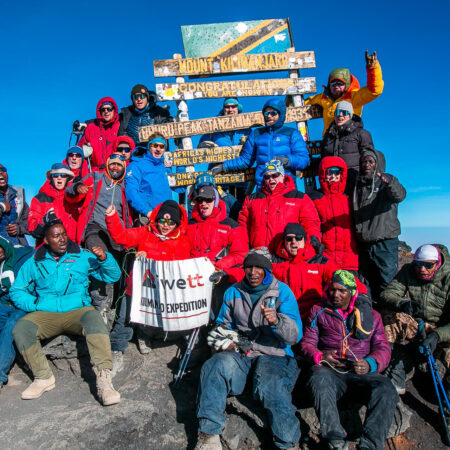
The first section of the route takes you up to Gilman’s Point (5,681 meters), a major landmark on the rim of the crater. From here, you’ll continue along the crater rim to Uhuru Peak (5,895 meters), the true summit of Kilimanjaro. This section will be especially challenging, as you’ll be dealing with extreme cold and thin air, but your determination will carry you through. As you stand at the summit, you’ll be rewarded with breathtaking panoramic views and a profound sense of achievement—you’re standing at the Roof of Africa!
After celebrating at Uhuru Peak, you will descend to Millennium Camp (3,950 meters) for the night. The descent is long but less taxing on the body compared to the ascent, allowing you to reflect on the extraordinary accomplishment of summiting Kilimanjaro. The route back takes you through the Moorland Zone, where the air becomes richer and temperatures warmer.
Once at Millennium Camp, you’ll have a well-deserved rest and enjoy a celebratory dinner. The air will be thinner at this elevation, so be sure to stay hydrated and continue to take it easy as your body recovers from the strenuous ascent.
Highlights of the Day:
Summit Success: Reaching Uhuru Peak, the highest point on Mount Kilimanjaro, is the ultimate highlight of your trek.
Sunrise at the Summit: Catch a stunning sunrise as you approach Uhuru Peak, with the incredible views of the glaciers and surrounding landscape.
Descent to Millennium Camp: After reaching the summit, the descent to Millennium Camp allows you to reflect on your achievement and enjoy the warmer air.
Elevation Gain:
Uhuru Peak: 1,115 meters
Descent to Millennium Camp: -1,945 meters
Day 9 Trek – Millennium Camp (3,950 meters) to Mweka Gate (1,650 meters) to Kilimanjaro International Airport
Elevation Loss: 2,300 meters
Hiking Time: 4–5 hours
Habitat: Moorland to Montane Forest
Accommodation: N/A (End of the trek)
After a restful night at Millennium Camp, your final day on Mount Kilimanjaro begins with an early breakfast and the journey back to civilization. Today’s trek is a steady and scenic descent from the alpine moorland down to the lush montane rainforest, where the temperature becomes warmer and the oxygen richer as you make your way down.
The trail can be muddy, especially after rainfall, so trekking poles and sturdy boots are recommended for good grip. Along the way, you’ll enjoy the refreshing, cooler air of the forest, where you might encounter local wildlife like birds and monkeys. The vibrant rainforest marks a stark contrast to the rocky terrain you’ve climbed, reminding you of the diverse ecosystems on the mountain.
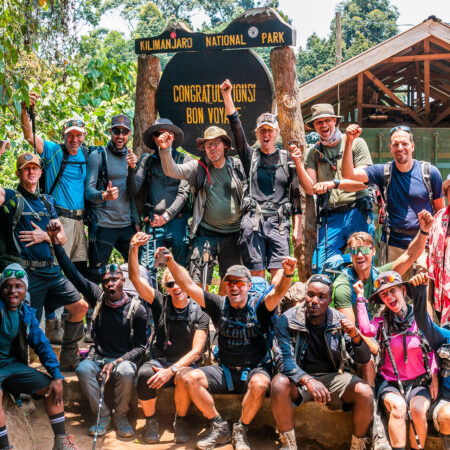
After a few hours of walking, you’ll reach Mweka Gate (1,650 meters), the official exit point of your trek. Here, you’ll sign out of the national park, and you’ll be awarded your Kilimanjaro climbing certificate, a well-deserved reward for your hard work and perseverance. It’s a moment to celebrate your incredible accomplishment!
Once you’ve signed out, you will be transferred to Kilimanjaro International Airport for your flight home or onward journey. Whether you’re heading to your next adventure or returning home, the sense of achievement will stay with you for years to come. Reflect on your experience, knowing you’ve reached the Roof of Africa.
Highlights of the Day:
Lush Forest Descent: Enjoy trekking through the shaded rainforest, listening to the sounds of birds and wildlife.
Mweka Gate Finish: Sign out and receive your official Kilimanjaro climbing certificate.
Transfer to Kilimanjaro International Airport: After completing your climb, relax as you are transferred back to the airport.


Ut enim ad minim veniam, quis nostrud exercitation ullamco laboris nisi ut aliquip ex ea commodo consequat. Duis aute irure dolor in reprehenderit in